In the luxury spirits landscape, brand building has traditionally been a slow, linear grind. Historically, turning a high-level liquid concept into a tangible, physical bottle required months of iterative graphic design, costly physical prototyping, and endless back-and-forth between creative agencies and production houses. But as the market accelerates and consumer attention spans shrink, the luxury sector is undergoing a quiet revolution.
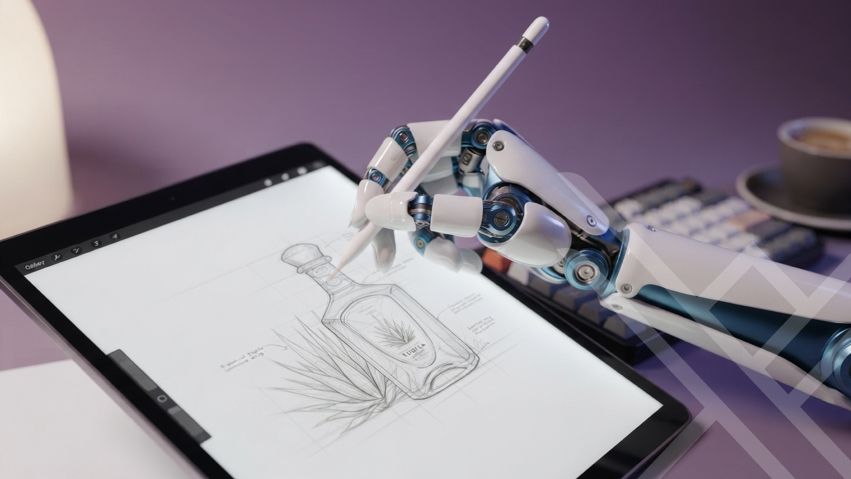
Generative Artificial Intelligence (AI) has emerged not as a replacement for human craft, but as a high-velocity engine for rapid concept art, disruptive label design, and strategic brand architecture.
For spirit founders, brand managers, and investors, understanding how to leverage Generative AI during the ideation phase is no longer an experimental luxury—it is a formidable competitive advantage.
Here are four core principles that define how Generative AI is reshaping concept development for ultra-premium spirit labels:
Unlocking Rapid Iteration in Concept Development
In traditional branding workflows, testing five distinct design directions meant weeks of mood boarding and initial vector sketching. Generative AI fundamentally shifts this paradigm by compressing months of aesthetic exploration into hours. By inputting precise stylistic parameters—ranging from Victorian-era engraving styles and minimalist industrial architecture to organic botanical illustrations—brand architects can explore dozens of visual archetypes instantaneously.
This rapid iteration allows brand owners to stress-test high-concept ideas, color palettes, and structural shapes long before committing capital to final vector rendering or print die-cuts.
Visualizing Complex Brand Narratives
The most compelling luxury brands tell intricate stories that blend heritage, geology, and liquid craft. AI tools excel at synthesizing abstract strategic concepts into vivid, high-fidelity visual assets. Whether visualizing the microscopic mineral structures of volcanic soil, hyper-detailed endemic flora, or futuristic geometric glasswork,
AI allows design teams to push creative boundaries far beyond conventional stock imagery or predictable template structures. It translates the emotional and technical spirit of a brand into immediate, arresting concept art.
De-risking Product Launches and Market Validation
Bringing a new ultra-premium product to market carries inherent financial risk. Before investing in custom glass molds, hot-foil stamping dies, or specialized paper stocks, Generative AI enables founders to create photorealistic 3D concepts for qualitative market testing.
Brand teams can present high-tier visual assets to distributors, importers, and focus groups to gauge emotional resonance, visual hierarchy, and shelf presence prior to mass production. In essence, AI de-risks the creative pipeline by turning hypothetical ideas into actionable data points.
The Tailor-Made Touch: Why Human Curation Beats Generic Algorithms
Despite its rapid speed, raw Generative AI has a critical limitation: left on its own, it regurgitates trends and yields generic, highly repetitive visual concepts. True luxury, by definition, demands exclusivity and bespoke distinction. An algorithm can generate a beautiful surface image, but it lacks brand intuition, cultural context, and artistic discrimination.
The true magic happens in the hybrid model: using AI as a hyper-efficient brainstorming engine, which is then curated, elevated, and customized by expert human brand strategists. The human touch transforms a generic AI output into a unique, tailor-made work of art, while engineering it to meet strict print specifications, embossing parameters, and international regulatory compliance.
This exploration into technological innovation is the logical progression of our recent analysis, “Mezcal Terroir: How Soil Influence Defines Agave Profiles Across Mexico.” In that study, we established that creating an elite liquid asset requires bridging raw, organic origin with precise, systematic process control.
The same rule applies to brand identity: whether you are cultivating raw agave in volcanic soil or generating initial label art with algorithms, raw output means nothing without bespoke human refinement. An incredible AI concept is useless if it feels generic or cannot be translated into a physical, regulatory-compliant, and manufacturable packaging asset that elevates your liquid inside the bottle.
At Aceves Spirits Co., innovation is built into every layer of our operational model. We don’t just engineer world-class, additive-free liquids and manage complex bulk logistics; we help brand owners navigate the entire end-to-end journey of product creation.
By pairing cutting-edge tools like Generative AI for initial ideation with our deep human expertise in luxury design and industrial manufacturing, we help our partners shorten development cycles, eliminate creative clichés, and seamlessly transition disruptive, tailor-made concepts into physical, shelf-ready luxury assets.
The future of luxury spirit creation belongs to those who pair disruptive innovation with bespoke human craftsmanship and unyielding execution.
Is your brand concept engineered for the future, or trapped in traditional bottlenecks? Visit Aceves Spirits Co. at acevesspirits.com to discover how we professionalize private label development, integrate cutting-edge innovation, and architect world-class spirits from concept to bottle.